Rolling capacity
The rolling line is built around a 3-roll hydraulic plate rolling machine sized for heavy work. These are the limits we quote against:
| Parameter | Capacity |
|---|---|
| Maximum plate thickness | 50 mm |
| Maximum plate width (shell length per course) | 3 m (3,000 mm) |
| Sections | Cylindrical shells, and conical sections — cones and reducers |
| Materials | Carbon steel, low-temperature carbon steel (LTCS) and stainless steel |
| Blank preparation | CNC plasma and oxy-fuel profile cutting on plates up to 3 m × 12 m, with weld-edge bevelling |
| Forming | 150 MT hydraulic press |
If your shell is near a limit, send the drawing anyway. Whether a section can be rolled depends on thickness, diameter and grade together, and it is quicker for us to check than for you to guess.
What we roll
Shells for storage tanks, pressure vessels, columns, drums, ducts and silos; cones and reducers for vessel transitions and hoppers; and heavy cylindrical sections for structural and process equipment. EPC contractors and equipment manufacturers typically bring us rolling work when they need workshop capacity at that thickness, a specialised welding capability, or schedule relief.
Rolled, welded and tested under one roof
A rolled shell is rarely the end of the job. Moving plates between a cutting vendor, a roller and a welding shop costs time, handling damage and accountability. At Kalol the whole sequence stays in one shop and one inspection plan:
- Cut — CNC profile cutting of the blank, with the weld bevel prepared.
- Roll — cylindrical or conical, to the drawing.
- Weld — long seams and circumferential seams on the submerged arc welding (SAW) station, which gives the high deposition, low distortion and consistent fusion that thick-wall seams need. SMAW, GMAW, GTAW and FCAW are also qualified.
- Test — hydrostatic or pneumatic testing, dye-penetrant testing and dimensional inspection in-house; radiography by an approved NDT agency.
- Finish — abrasive blasting to SA 2.5 and painting to your system.
Quality you can audit
Thick sections are where welding procedure matters most, so the paperwork is part of the deliverable, not an extra:
- Welders and procedures qualified to ASME Section IX, with WPS/PQR available for review.
- PMI and mill test certificate (MTC) traceability on every plate and weldment.
- Dimensional reports, weld maps, hydrotest charts from calibrated gauges and chart recorders, and paint film-thickness reports.
- Third-party inspection accepted — Lloyd’s, BV, TÜV, RINA and IBR.
How to get a job-work quote
Send the drawing and we will come back with a budgetary price and a slot. The fastest route is the form at the foot of this page, or WhatsApp the drawing to +91-95100-34854, or email it to info@hail.ltd. A useful enquiry tells us:
- the drawing, with material grade and plate thickness
- quantity, and whether the job repeats
- whether material is free-issue or for us to procure
- the code or standard, and who inspects (your QA, or a TPI agency)
- the date you need it despatched
Where the work is done
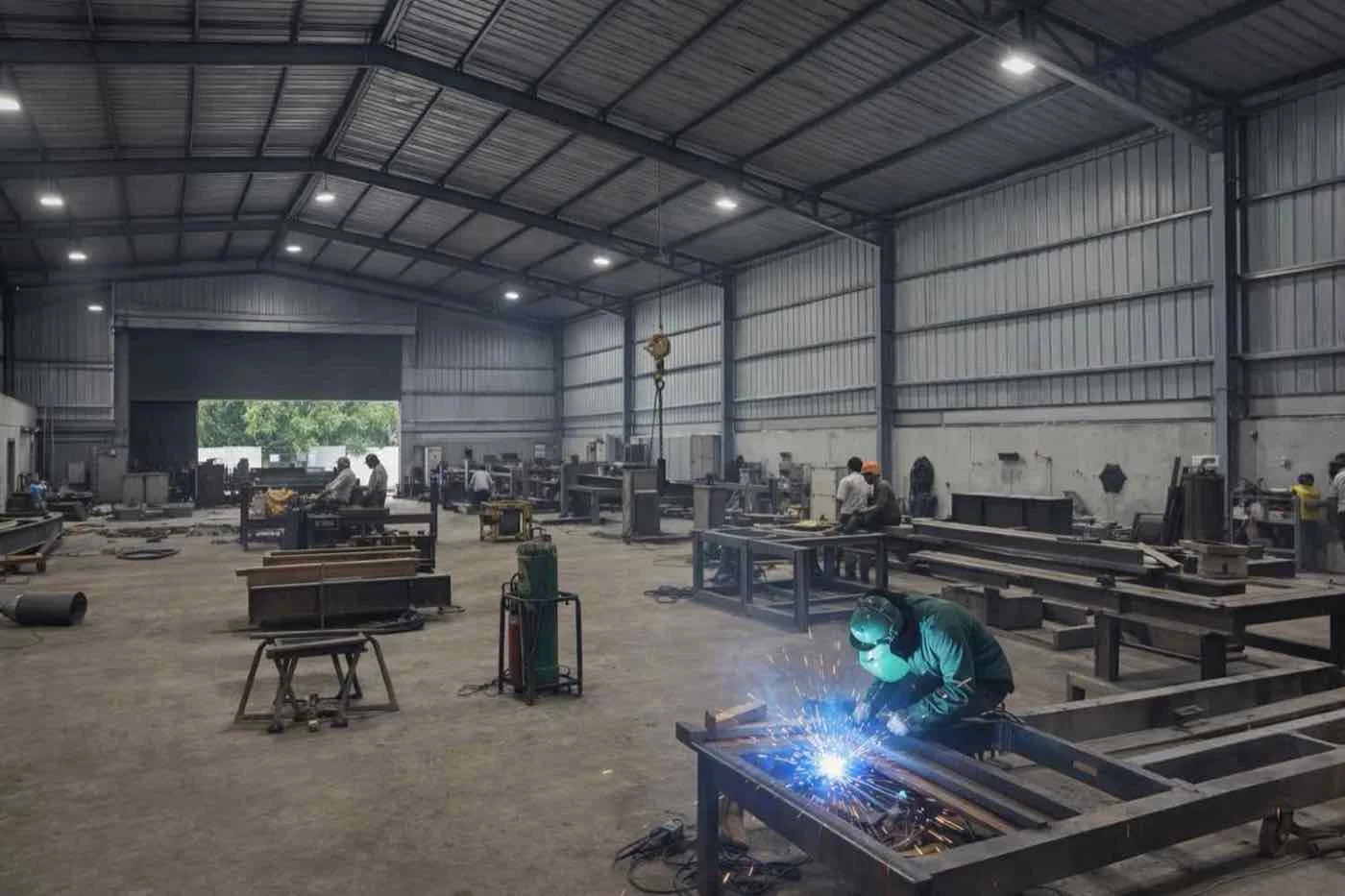
HAIL’s workshop sits on a 33,000 sq.ft. plot with a 17,800 sq.ft. fabrication shed, an overhead gantry crane for material handling, and a lay-down area for staging large assemblies before despatch. Address: Plot No. 1237/1, State Highway No. 5, Village Delol, Taluka Kalol, District Panchmahal, Gujarat 389310.
Frequently asked questions — heavy plate rolling job work
What is the maximum plate thickness you can roll?
Up to 50 mm thick and up to 3 m wide, on a 3-roll hydraulic plate rolling machine. Whether a particular shell can be rolled depends on thickness, diameter and material grade together, so send the drawing and we will confirm.
Can you roll cones and reducers as well as cylinders?
Yes. We roll cylindrical shells and conical sections — cones, reducers and hopper transitions — for tanks, vessels, ducts and silos.
Do you also cut and weld the shells after rolling?
Yes. Blanks are CNC profile-cut with the weld bevel prepared, on plates up to 3 m × 12 m. Long and circumferential seams are welded on our submerged arc welding station, with all welders and procedures qualified to ASME Section IX.
Which materials do you roll?
Carbon steel, low-temperature carbon steel (LTCS) and stainless steel. For duplex and super duplex, see our duplex fabrication job work page.
Can I supply my own plate?
Yes — that is the usual arrangement for job work. Tell us whether material is free-issue or for us to procure, and we will quote accordingly.
Is third-party inspection allowed?
Yes. Third-party inspection by Lloyd’s, BV, TÜV, RINA or IBR is accepted, and we provide dimensional reports, weld maps and hydrotest charts.